In today’s fast-paced digital lifestyle, fast charging has moved from being a “nice to have” feature to an everyday necessity. Smartphones, tablets, wireless earbuds, smartwatches, power banks, and even laptops all rely on quick, efficient charging to keep users productive. As more households and offices adopt USB power strips with built-in cables and USB ports, a common question arises: does a USB power strip with cable actually support fast charging?
As an expert in the smart charging industry, I’ll break down how fast charging works, what role USB power strips play, and what factors determine whether a USB power strip with cable can truly deliver fast charging performance.
Understanding What “Fast Charging” Really Means
Before evaluating USB power strips, it’s important to understand fast charging itself. Fast charging is not just about plugging in a device—it’s a coordinated process between three key components:
- The power source (wall outlet, charger, or power strip)
- The cable
- The device being charged
Fast charging standards increase power delivery by raising voltage, current, or both, while using intelligent communication to protect the battery. Common fast-charging standards include:
- USB Power Delivery (USB-PD) – widely used for smartphones, tablets, and laptops
- Qualcomm Quick Charge (QC) – common on Android devices
- Apple Fast Charging – based on USB-PD
- Samsung Super Fast Charging – also USB-PD based
If any one of the three components does not support the required power level or protocol, fast charging will not activate.
What Is a USB Power Strip with Cable?
A USB power strip with cable combines a traditional AC power strip with integrated USB-A and/or USB-C ports. Some models also include built-in charging cables, eliminating the need to carry extra cords.
These power strips are popular in homes, offices, hotels, and travel scenarios because they:
- Reduce cable clutter
- Allow multiple devices to charge simultaneously
- Offer convenience for shared charging spaces
However, convenience does not automatically equal fast charging capability.
Can a USB Power Strip Support Fast Charging?
The Short Answer: Yes, but only under certain conditions
Not all USB power strips with cable are designed for fast charging. Whether fast charging works depends on several technical factors.
1. Power Output of the USB Ports
The most important factor is output power, measured in watts (W).
- Standard USB charging: 5V / 1A–2.4A (5–12W)
- Fast charging:
- 18W (basic fast charging)
- 20–30W (modern smartphones)
- 45W–65W+ (tablets and laptops)
Many basic USB power strips only provide 5V/2.1A or 2.4A, which is not fast charging by modern standards.
To support fast charging, a USB power strip should offer:
- USB-C ports with at least 18W output
- Preferably 30W, 45W, or higher for newer devices
If the power strip lacks sufficient wattage, fast charging will not engage—even if the device supports it.
2. Fast Charging Protocol Support
Fast charging is not only about power—it also requires communication protocols.
A USB power strip must support protocols such as:
- USB Power Delivery (PD)
- Quick Charge (QC 3.0 / QC 4.0)
- Manufacturer-specific protocols (Apple, Samsung, Huawei, etc.)
Without protocol support, the charger will default to standard 5V charging. Many older or low-cost USB power strips do not include intelligent protocol chips, limiting their charging speed.
3. Built-In Cable Quality and Rating
When a USB power strip includes a built-in cable, the cable itself becomes a critical factor.
For fast charging:
- USB-C cables must be rated for high current
- 3A cables support up to 60W
- 5A cables (with E-marker chips) support up to 100W
If the built-in cable is low-quality or only designed for basic charging, it will limit power delivery—even if the USB port supports fast charging.
This is a common reason users experience slow charging with “all-in-one” power strips.
4. Power Sharing Between Multiple Devices
USB power strips are often used to charge several devices at the same time. In these situations, total output power is divided among connected devices.
例えば:
- A power strip with 60W total USB output
- Four devices plugged in simultaneously
- Each device may only receive 10–15W
Some advanced power strips use smart power allocation, dynamically distributing power based on device demand. Cheaper models often split power evenly, reducing charging speed.
If you want reliable fast charging, check whether the power strip supports intelligent power management.
5. AC Outlet vs USB Charging
It’s also important to note that some users achieve fast charging by plugging a separate fast charger into the AC outlets on a power strip.
In this case:
- The USB power strip itself is not doing the fast charging
- The wall charger handles power conversion and protocol negotiation
This method can deliver full fast-charging performance, but it defeats the purpose of relying solely on the built-in USB ports.
Safety and Thermal Considerations
Fast charging generates more heat and requires better electrical design. High-quality USB power strips with fast charging include:
- 過電流保護
- 過電圧保護
- 過熱保護
- Fire-resistant materials
Low-quality power strips may advertise “fast charging” but throttle power to prevent overheating, resulting in inconsistent performance.
Certifications such as UL, ETL, CE, or FCC are strong indicators of safe and reliable fast-charging capability.
When Does a USB Power Strip Work Well for Fast Charging?
A USB power strip with cable is suitable for fast charging if it meets the following criteria:
- USB-C ports with 18W+ output
- Explicit support for USB-PD or QC
- High-quality built-in cables rated for fast charging
- Smart power distribution
- Recognized safety certifications
These models are ideal for:
- Smartphones and tablets
- Office desks and nightstands
- Shared charging environments
- Minimalist setups with fewer wall chargers
When It May Not Be the Best Choice
A USB power strip may not be ideal for fast charging if:
- You charge power-hungry devices like laptops daily
- The strip only offers low-power USB-A ports
- Multiple devices are always connected at once
- Built-in cables are not replaceable
In these cases, a dedicated fast charger or high-power USB-C charger may be more reliable.
Final Verdict
So, does a USB power strip with cable work with fast charging?
Yes—but only if it is specifically designed for it.
Fast charging depends on power output, protocol support, cable quality, and power management. While many modern USB power strips can deliver fast charging speeds, basic or older models often cannot.
For consumers, the key is to look beyond marketing claims and check technical specifications. For businesses and manufacturers, investing in properly engineered fast-charging USB power strips is essential to meet modern user expectations.
As fast charging continues to evolve, USB power strips are no longer just simple accessories—they are becoming intelligent charging hubs. Choosing the right one makes all the difference between slow overnight charging and truly fast, efficient power delivery.
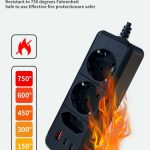
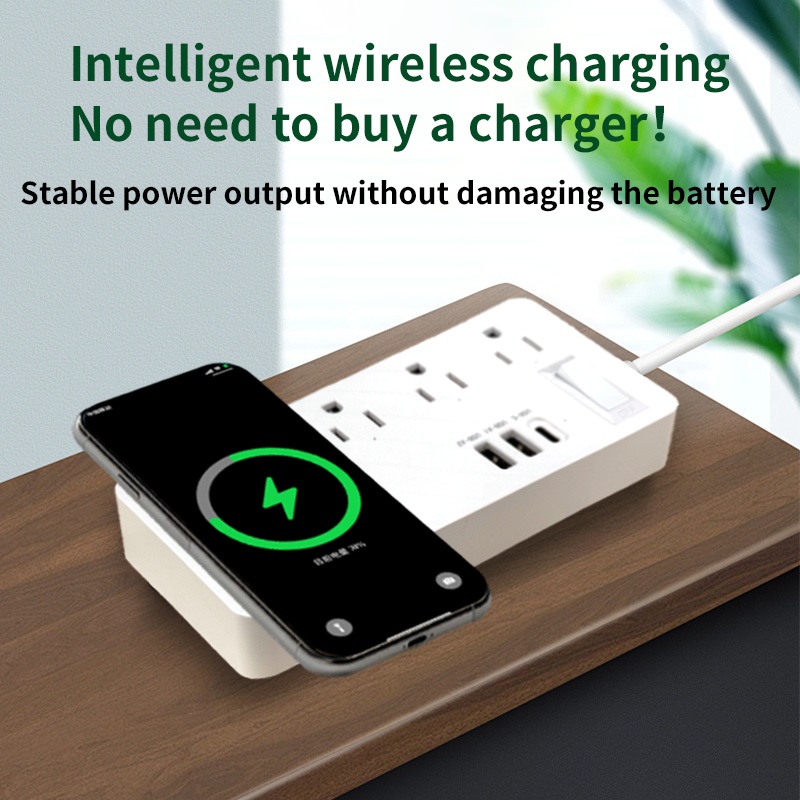
To help overseas customers enjoy fast, safe, and convenient charging in one compact solution, we proudly introduce our 2406-PL US Standard USB Power Strip with Wireless Charging. Designed for modern homes, offices, and international markets, this product combines 3 US-standard AC outlets, 2 USB-A ports, 1 high-power USB-C port, and a built-in wireless charger into a sleek, fireproof ABS housing. With USB-A and USB-C fast charging up to 30W, it easily supports smartphones, tablets, and other smart devices, while the AC 100–240V wide voltage input makes it ideal for global use. The integrated copper wire (0.75 mm², 1.2 m length) ensures stable power delivery, and the customizable logo option helps overseas distributors and brand owners build their own identity. Available in classic white or black, this compact power strip is an excellent choice for retailers, wholesalers, and OEM/ODM partners looking to offer a reliable, fast-charging USB power strip tailored to international customers.
あなたにおすすめ
 ケーブル付きの USB 電源タップは充電に使用しても安全ですか?
- ワイヤレス充電器には特別なアダプターやプラグが必要ですか?
- Fast Wireless Chargers: What to Look For (Supplier Guide)
- Intelligent In-Car Spray Aromatherapy – Smart Auto Spray Car Air Freshener for Modern Vehicles
- 15W マグネット式折りたたみ式ワイヤレス充電器スタンド スマートウォッチ/イヤホン用急速充電
- 車用ワイヤレス充電器 エアベントタイプ 急速充電オプション
- 高速ワイヤレス充電に対応したMagSafe搭載のポータブル3 in 1トラベルチャージャー
- 充電式車用芳香剤
- 円形高速ワイヤレス充電器
- New Arrival Desktop Wireless Charger 3-in-1 Fast Charging Station for Mobile Phones for Mobile Headphones