Wireless charging has evolved rapidly over the last decade. What began as a slow, convenience-focused alternative to cables has become a serious contender for fast daily charging. As an expert in the smart charging industry, I’m often asked a simple but important question: what is the most powerful wireless charger available today? The answer depends on how you define “powerful,” which devices you use, and how much real-world performance you expect from a wireless charger or wireless phone charger.
In this article, we’ll explore the highest wireless charging power levels currently on the market, how those numbers are achieved, and whether ultra-high-watt wireless charging actually makes sense for most users.
Understanding “power” in wireless charging
When people ask about the most powerful wireless charger, they usually mean maximum wattage output. Wattage determines how much electrical power can be transferred from the charger to your device. In wired charging, this is straightforward: higher wattage almost always means faster charging. Wireless charging, however, is more complex.
Wireless charging relies on electromagnetic induction between a transmitting coil (in the charger) and a receiving coil (in the phone). Because there is no physical connection, efficiency is lower than wired charging. Some power is always lost as heat. As a result, higher wattage requires more advanced coil design, tighter alignment, better thermal management, and smarter communication between the charger and the phone.
The current peak: 50W to 80W wireless chargers
As of today, the most powerful consumer wireless chargers reach peak outputs in the 50W to 80W range. These chargers are typically sold as premium wireless charging stands rather than simple flat pads. They are designed to work with specific smartphone models that support proprietary high-power wireless charging protocols.
Manufacturers that push wireless charging into this ultra-high-watt category usually combine several technologies:
- Multi-coil or adaptive coil systems for better alignment
- Active cooling systems such as built-in fans
- Proprietary communication between phone and charger
- High-watt wired power adapters (often 90W–120W input)
Under ideal conditions, these chargers can deliver power levels that rival or even exceed many standard wired chargers.
However, it’s critical to understand that the charger alone does not determine charging power.
Device compatibility matters more than the charger rating
Even if you buy the most powerful wireless charger available, your phone will only charge at the maximum power it is designed to accept.
Ví dụ:
- Many Android phones support 15W to 30W wireless charging.
- Some flagship or gaming phones support 40W, 50W, or higher wireless charging using proprietary systems.
- Most iPhones traditionally charge at up to 15W wirelessly, even when using premium magnetic accessories.
This means that an 80W wireless charger will not magically charge all phones at 80W. Instead, the charger and phone “negotiate” a safe power level they both support. For most users, that negotiated level is far below the charger’s advertised maximum.
Why mainstream phones don’t use extreme wireless wattage
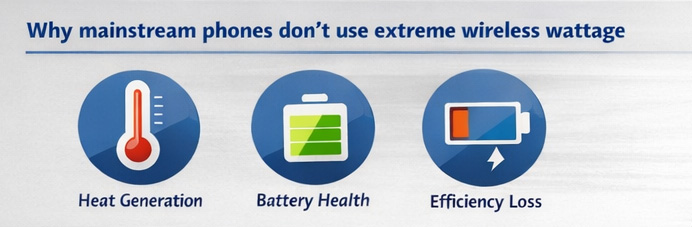
If 80W wireless charging exists, why don’t all phones use it? The answer comes down to heat, efficiency, and battery longevity.
Heat generation
Wireless charging already produces more heat than wired charging. At very high power levels, heat can build up quickly, stressing internal components and the battery. Even with cooling systems, sustained high-watt wireless charging can make devices uncomfortably warm.
Battery health
Lithium-ion batteries degrade faster when exposed to high temperatures and high charging currents. Phone manufacturers must balance charging speed with long-term battery health, especially for devices expected to last several years.
Efficiency concerns
At extreme wattage, efficiency drops. More energy is wasted as heat, which is not only less environmentally friendly but also harder to manage safely in compact devices.
For these reasons, many manufacturers intentionally cap wireless charging power at more conservative levels.
The role of Qi, Qi2, and proprietary standards
Most wireless phone charger products rely on the Qi wireless charging standard, which ensures broad compatibility across brands. Qi has historically supported lower wattage levels, prioritizing safety and interoperability.
Newer evolutions, such as Qi2, improve magnetic alignment and efficiency, making 15W–25W wireless charging more stable and consistent. While Qi2 doesn’t aim to compete with 80W proprietary systems, it offers a much better everyday experience for the majority of users.
Ultra-high-power wireless charging, on the other hand, almost always relies on proprietary standards. These systems work extremely well within a specific brand ecosystem but offer little benefit if you use multiple devices from different manufacturers.
What “most powerful” really means for everyday users
From a purely technical standpoint, the most powerful wireless charger available today is one rated around 80W. That is the current upper limit of what consumers can realistically buy.
From a practical standpoint, however, the “most powerful” charger is often not the best charger.
For most users:
- A high-quality 15W–30W wireless charger delivers excellent performance.
- Heat levels remain manageable.
- Compatibility across phones, earbuds, and accessories is far better.
- Charging overnight or during work hours is more than fast enough.
In real-world use, the difference between 30W and 80W wireless charging is far less dramatic than the numbers suggest.
Choosing the right wireless charger for your needs
When selecting a wireless charger or wireless phone charger, consider the following questions:
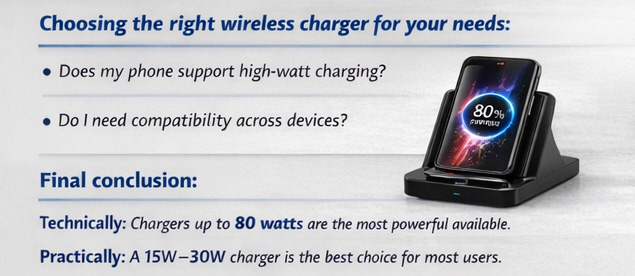
- Does my phone support high-watt wireless charging?
- Do I prioritize maximum speed or long-term battery health?
- Will I charge multiple devices with the same charger?
- Do I want magnetic alignment for convenience and stability?
If you own a phone specifically designed for ultra-fast wireless charging, investing in the manufacturer’s high-power wireless charger makes sense. If not, a well-designed Qi or Qi2 charger will give you a better balance of speed, safety, and versatility.
Final conclusion
So, what is the most powerful wireless charger available?
Technically: Wireless chargers with peak outputs of up to 80 watts represent the highest power currently available to consumers.
Practically: For the vast majority of users, the most effective wireless charger is one that delivers 15W–30W reliably, efficiently, and safely, with excellent alignment and thermal control.
Wireless charging is no longer just about convenience—it’s a mature, high-performance technology. As standards improve and efficiency increases, we may see even higher wireless power levels become mainstream. Until then, understanding your device’s capabilities is far more important than chasing the biggest watt number on the box.
Bạn có thể thích
 Why Are So Many Global Brands Sourcing Wireless Chargers from China?
- Máy khuếch tán tinh dầu thơm USB
- Best Wireless Charging Solutions for Retail Brands
- Sự khác biệt giữa ổ cắm điện USB và bộ chuyển đổi là gì?
- Bảng mạch điện kiểu Châu Âu dài 5 ft có ổ cắm điện USB và Type-C Kiểu EU có dải dây
- Bộ sạc không dây đa năng 4 trong 1
- Bộ sạc không dây có hoạt động với ốp lưng điện thoại không?
- Những lợi ích ngày càng tăng của bộ sạc điện thoại không dây: Từ năng lượng đến cuộc sống thông minh đa chức năng
- Đế sạc không dây di động 3 trong 1 15W có thể gập lại dành cho iPhone AirPods Apple Watch
- Bộ sạc không dây đa cổng USB 15W + giao diện 3USB