Wireless charging has become one of the most important technologies in modern consumer electronics. From smartphones and earbuds to smartwatches and automotive accessories, wireless power transfer is now widely adopted across multiple industries. At the center of every wireless charging device lies a critical component known as the Wireless Charger PCBA.
A Wireless Charger PCBA, or Printed Circuit Board Assembly, serves as the brain and control center of a wireless charging product. It manages power conversion, charging communication, voltage regulation, temperature protection, and overall system stability. Without a high-quality PCBA, even the most attractive wireless charger design cannot deliver safe, efficient, and reliable performance.
As global demand for wireless charging products continues to rise, manufacturers, OEM brands, and electronics buyers are increasingly searching for advanced Wireless Charger PCBAs that support faster charging speeds, higher efficiency, and better compatibility with modern devices.
This article explains what a Wireless Charger PCBA is, how it works, its key components, manufacturing process, advantages, applications, and future trends in the wireless charging industry.
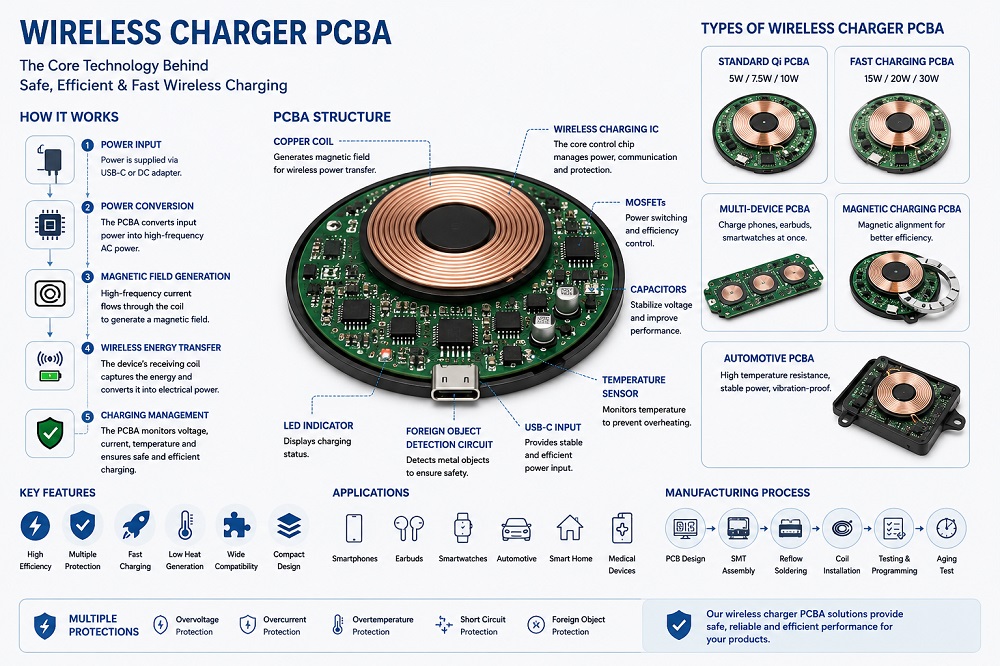
What Is a Wireless Charger PCBA?
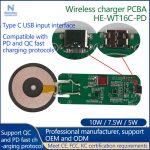
A Wireless Charger PCBA is the assembled electronic circuit board used inside wireless charging devices. It integrates electronic components such as IC chips, capacitors, coils, MOSFETs, transformers, resistors, and communication modules onto a PCB to create a complete wireless charging control system.
The PCBA performs several important functions:
Converting power from AC or USB input into wireless energy
Managing voltage and current output
Detecting compatible devices
Protecting against overheating and overcurrent
Ensuring charging efficiency and safety
Supporting wireless charging protocols such as Qi
Most modern wireless chargers rely on electromagnetic induction technology. The PCBA controls the transmission coil to generate a magnetic field, which transfers energy to the receiving coil inside the smartphone or electronic device.
How Does a Wireless Charger PCBA Work?
The operating principle of a Wireless Charger PCBA is based on electromagnetic induction.
Here is a simplified explanation of the process:
1. Power Input
The wireless charger receives power through a USB-C port, Micro USB port, or DC adapter. The input power is delivered to the PCBA.
2. Power Conversion
The PCBA converts the incoming electrical power into high-frequency alternating current through control ICs and power management circuits.
3. Magnetic Field Generation
The alternating current flows through the charging coil mounted on the PCBA. This generates an electromagnetic field.
4. Wireless Energy Transfer
When a compatible device is placed on the charging pad, the receiving coil inside the device captures the magnetic energy and converts it back into electrical power.
5. Charging Management
The PCBA continuously monitors temperature, voltage, current, and foreign object detection to ensure safe and stable charging.
Main Components of a Wireless Charger PCBA
A high-performance Wireless Charger PCBA contains multiple precision electronic components working together.
Wireless Charging IC
The wireless charging IC is the core controller of the system. It manages power transfer, communication protocols, and charging efficiency.
Popular wireless charging chip suppliers include:
- Texas Instruments
- NXP
- STMicroelectronics
- NuVolta
- ConvenientPower
Copper Coil
The charging coil generates the magnetic field necessary for wireless power transfer. Coil design significantly affects charging efficiency and heat generation.
MOSFETs
MOSFETs are responsible for switching and power control. High-quality MOSFETs improve efficiency and reduce energy loss.
Capacitors and Resistors
These components stabilize voltage and current throughout the charging process.
Foreign Object Detection Circuit
This safety feature prevents metal objects such as coins or keys from overheating during charging.
Temperature Protection Module
Temperature sensors monitor heat levels and protect both the charger and the connected device.
LED Indicators
LED indicators display charging status, standby mode, or fault conditions.
Types of Wireless Charger PCBAs
Wireless Charger PCBAs are available in different configurations depending on the application.
Standard Qi Wireless Charger PCBA
Supports mainstream smartphones with Qi wireless charging compatibility.
Common output power:
- 5 W
- 7.5W
- 10 W
- 15 W
Fast Wireless Charging PCBA
Designed for high-speed charging with advanced power management.
Features:
- Higher efficiency
- Boljše upravljanje temperature
- Fast charging protocols
Multi-Device Charging PCBA
Supports simultaneous charging for multiple devices such as:
- Pametni telefoni
- Earbuds
- Pametne ure
Magnetic Wireless Charging PCBA
Compatible with magnetic alignment systems similar to MagSafe technology.
Advantages include:
- Better charging alignment
- Improved charging efficiency
- Enhanced user experience
Automotive Wireless Charging PCBA
Used in car wireless charging pads and automotive accessories.
Requirements include:
- High temperature resistance
- Stabilna dobava energije
- Vibration durability
Advantages of High-Quality Wireless Charger PCBAs
Improved Charging Efficiency
A professionally designed PCBA minimizes energy loss during power transfer.
High-end wireless charging PCBAs can achieve efficiency rates above 75%.
Better Safety Protection
Advanced protection systems reduce risks such as:
- Overheating
- Overvoltage
- Overcurrent
- Short circuits
Faster Charging Speeds
Optimized circuit design supports fast wireless charging standards.
Reduced Heat Generation
Efficient power conversion lowers operating temperature and improves product lifespan.
Wider Compatibility
High-quality PCBAs support multiple brands and devices.
Compact Design
Modern PCBAs allow thinner and smaller wireless charging products.
Manufacturing Process of Wireless Charger PCBAs
The production of Wireless Charger PCBAs requires precision engineering and strict quality control.
PCB Design
Engineers create the PCB layout based on charging requirements, thermal performance, and electromagnetic compatibility.
SMT Assembly
Surface Mount Technology (SMT) machines place electronic components onto the PCB with high precision.
Reflow Soldering
The PCB passes through a reflow oven to permanently solder components onto the board.
Coil Installation
The wireless charging coil is integrated with the PCBA.
Firmware Programming
Charging protocols and power management software are programmed into the IC.
Functional Testing
Each PCBA undergoes testing for:
- Charging performance
- Thermal stability
- Safety protection
- Compatibility
Aging Test
Long-term operation tests ensure product reliability.
Important Features to Consider When Choosing a Wireless Charger PCBA
For OEM brands and electronics manufacturers, selecting the right PCBA supplier is essential.
Qi Certification Support
Qi-certified PCBAs provide better compatibility and safety assurance.
Učinkovitost polnjenja
Higher efficiency means less heat and better performance.
Thermal Management
Good thermal design improves durability and user safety.
Customization Capability
Reliable suppliers can customize:
- PCB size
- Coil structure
- Power output
- Firmware
- LED indicators
Safety Compliance
Look for compliance with:
- CE
- Zvezna komisija za komunikacije (FCC)
- RoHS
- Qi standards
Stable Supply Chain
A professional manufacturer should offer consistent component sourcing and production stability.
Applications of Wireless Charger PCBAs
Wireless Charger PCBAs are widely used across many industries.
Smartphone Wireless Chargers
The most common application is mobile phone charging pads and stands.
Wireless Charging Furniture
Furniture brands integrate wireless charging PCBAs into:
Desks
Tables
Bedside cabinets
Automotive Electronics
Wireless charging systems are increasingly installed in vehicles.
Smart Home Devices
Many smart home products use wireless charging modules.
Medical Electronics
Wireless power transfer improves convenience and waterproof performance in medical devices.
Wearable Devices
Smartwatches and fitness trackers rely heavily on compact wireless charging PCBAs.
Challenges in Wireless Charger PCBA Development
Although wireless charging technology continues to advance, several technical challenges remain.
Heat Management
Fast charging generates significant heat, requiring better thermal design.
Electromagnetic Interference
Poor PCB layout may cause EMI problems affecting nearby electronics.
Charging Distance Limitations
Current wireless charging technology still requires close contact.
Cost Control
High-performance components increase production costs.
Compatibility Issues
Different brands may use different charging protocols.
Future Trends of Wireless Charger PCBAs
The wireless charging industry is evolving rapidly, creating new opportunities for PCBA manufacturers.
Higher Power Wireless Charging
Future PCBAs will support faster charging speeds exceeding 50W or even 100W.
GaN Technology Integration
Gallium Nitride technology can improve efficiency and reduce charger size.
Smart Power Management
AI-based power control systems may optimize charging performance automatically.
Longer Distance Charging
Researchers are developing over-the-air wireless charging solutions.
Multi-Function Integration
Future PCBAs may combine:
- Brezžično polnjenje
- Bluetooth
- Ambient lighting
- Smart sensors
Eco-Friendly Design
Manufacturers are increasingly using environmentally friendly PCB materials and energy-efficient solutions.
Why OEM Brands Prefer Custom Wireless Charger PCBAs
Many global electronics brands choose customized Wireless Charger PCBAs instead of generic solutions.
Custom PCBAs allow brands to:
- Create unique product designs
- Improve charging efficiency
- Differentiate products in the market
- Add exclusive features
- Optimize product cost
Professional PCBA manufacturers can provide complete OEM and ODM services, including product design, firmware development, certification assistance, and mass production support.
Zaključek
Wireless Charger PCBAs are the technological foundation behind modern wireless charging products. As consumers demand faster, safer, and more convenient charging solutions, the importance of high-quality PCBA design continues to grow.
From smartphones and automotive electronics to smart homes and wearable devices, Wireless Charger PCBAs play a crucial role in powering next-generation electronic products.
For brands, importers, and product developers, choosing a reliable Wireless Charger PCBA manufacturer is essential for achieving product quality, safety compliance, and long-term market success.
With ongoing advancements in fast charging, magnetic alignment, GaN technology, and smart power management, the future of Wireless Charger PCBAs looks highly promising. Companies that invest in innovative wireless charging technologies today will be well-positioned to compete in the rapidly expanding global electronics market.
Morda vam bo všeč
 15W hitri polnilnik z brezžičnim avtomobilskim stojalom
- Kateri telefoni podpirajo tehnologijo brezžičnega polnjenja?
- 3 v 1 postaja za brezžično polnjenje, stojalo MPP25W, magnetni polnilnik, brezžični združljiv za serijo iPhone, AirPods in iWatch
- Kakšne so razlike med brezžičnimi polnilniki s certifikatom Qi in tistimi brez njega?
- Kakšna je razlika med brezžičnimi polnilniki Qi2 in MagSafe?
- Osvežilec zraka za avto
- Zakaj zložljivi potovalni polnilnik postaja obvezen tehnološki dodatek
- Izkusite prihodnost udobja – vaša rešitev za brezžično polnjenje telefona na enem mestu
- Po meri izdelan 10W hitri brezžični polnilnik za univerzalni mobilni telefon Micro Type-C
- Magnetni avtomobilski polnilnik za hitro polnjenje Qi2