Introduction: Why Car Phone Charging Has Become a Core Automotive Need
In today’s connected world, smartphones have become an essential part of driving. From navigation and communication to entertainment, ride-hailing, and mobile payments, the smartphone is now the central digital interface inside vehicles.
As a result, car phone charging solutions are no longer simple accessories, but a critical component of the modern automotive ecosystem.
From an industry manufacturing perspective, the global demand for car phone chargers is driven by several key factors: increased smartphone usage while driving, growth of ride-sharing and delivery services, popularity of in-car navigation and infotainment systems, rapid adoption of wireless charging technology, and the transition to electric and smart vehicles.
Traditional low-power car chargers are no longer sufficient. Modern drivers require fast, safe, stable, and intelligent car phone charging solutions that can support continuous use in demanding automotive environments.
This article provides a complete professional overview of car phone charging solutions, covering technology, product categories, safety standards, OEM and ODM customization, and future trends.
What Are Car Phone Charging Solutions?
A car phone charging solution refers to a complete system designed to deliver power efficiently and safely to smartphones inside vehicles. It includes not just the charger itself, but the entire power architecture such as power input design, output protocols, smart power management chips, thermal and mechanical protection, and automotive-grade materials.
From a manufacturer’s point of view, a true car phone charging solution is not a single product, but a combination of electrical engineering, automotive safety standards, user experience design, and long-term reliability.
Core Technology Behind Car Phone Charging
Automotive Power Systems
Most passenger cars operate on a 12V DC electrical system, while trucks and commercial vehicles use 24V systems. Car phone chargers must handle wide voltage fluctuation, engine start voltage spikes, and long-term vibration and heat.
High-quality car phone chargers use intelligent DC-DC conversion modules to convert unstable vehicle power into stable charging output.
USB-C and Power Delivery
USB-C has become the global standard for fast phone charging. Modern car phone chargers typically support USB-C PD 18W, 30W, 45W, and also Quick Charge and PPS protocols.
From an industry perspective, USB-C Power Delivery is critical because it enables fast charging for both iPhone and Android devices and ensures future smartphone compatibility.
Wireless Car Phone Charging Technology
Wireless charging is one of the fastest-growing segments in car phone charging. Most wireless car phone chargers are based on the Qi wireless charging standard and support outputs ranging from 7.5W to 15W.
Wireless charging in vehicles requires much higher engineering standards than home use because of continuous vibration, high ambient temperature, and changing phone positions while driving. Therefore, automotive-grade wireless chargers require strong magnetic positioning, enhanced thermal management, and reinforced mechanical structures.
Main Categories of Car Phone Charging Solutions
USB Car Phone Chargers
These are the most common and widely used products. They usually feature dual USB-A or USB-C outputs, PD and QC fast charging support, compact plug-in designs, and LED indicators.
From a manufacturing perspective, this category focuses on cost efficiency, mass production, and universal compatibility, and is typically the entry-level product line for most brands.
Wireless Car Phone Charging Mounts
Wireless charging mounts combine a smartphone holder with a wireless charging system and an automatic clamping structure. They are especially popular for navigation use, ride-hailing drivers, and daily commuting.
Key engineering points include stable mounting structures, intelligent coil alignment, one-hand operation, and reliable overheat protection.
Magnetic Car Phone Chargers
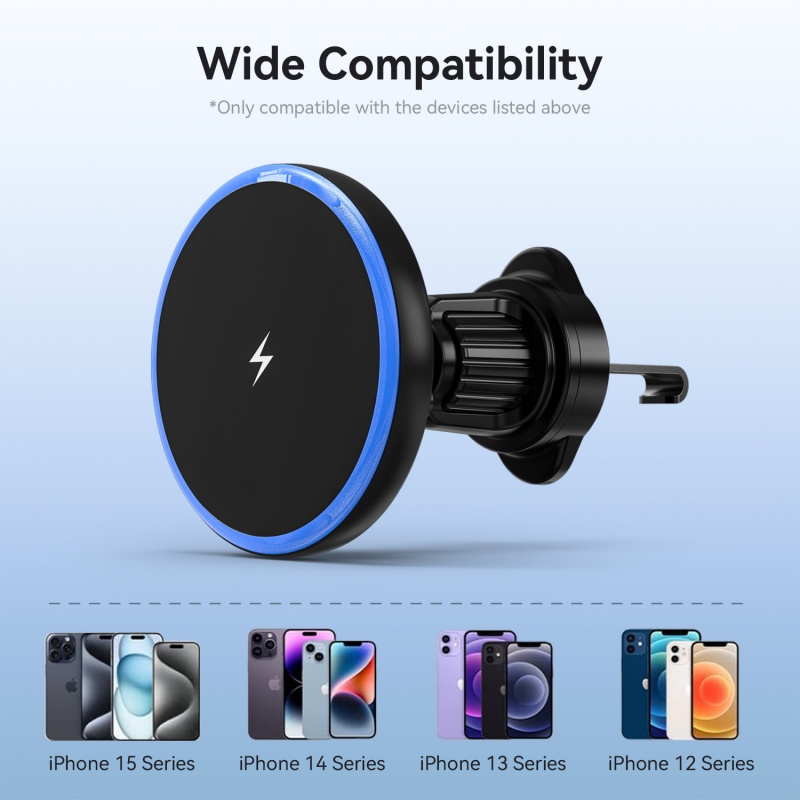
Magnetic wireless chargers are becoming mainstream, especially for iPhone users. They use magnetic alignment rings and strong magnets to ensure precise coil positioning.
The main advantages are perfect alignment, higher wireless charging efficiency, and better stability while driving. From a product strategy perspective, this segment represents the premium market of car phone charging solutions.
Multi-Device Car Phone Charging Hubs
Many users need to charge multiple devices simultaneously, such as the driver’s phone, passenger phones, and rear seat devices.
Multi-device charging hubs usually provide three to six USB outputs and are often designed with seat-back mounting for rear passengers. This category is especially suitable for family vehicles, taxis, ride-sharing services, and business travel cars.
Safety and Compliance in Automotive Charging
Safety is the most critical factor in car phone charging design. Professional manufacturers comply with international standards such as CE, FCC, RoHS, UL, and automotive EMC requirements.
Key safety systems include over-voltage protection, over-current protection, short-circuit protection, temperature monitoring, and smart power cut-off.
Car environments are more demanding than home or office environments due to high temperature, continuous vibration, dust, humidity, and long charging durations. Therefore, automotive phone chargers must be more robust and stable than standard consumer chargers.
Car Phone Charging in the Era of Electric Vehicles
The rise of electric vehicles is significantly increasing in-car digital usage. EV drivers rely heavily on navigation systems, charging station applications, battery monitoring platforms, and smart dashboards.
As a result, high-speed and stable car phone charging becomes even more important. Future EV-related trends include 65W or higher USB-C car charging, laptop-level charging inside vehicles, wireless charging built into dashboards, and integrated charging modules in center consoles.
Car phone charging is evolving from an accessory into a standard feature of smart vehicles.
OEM and ODM Customization for Car Phone Charging Solutions
From a manufacturing standpoint, OEM and ODM services are the core growth engine of the car phone charging industry.
Typical customization options include output power levels, USB port combinations, wireless or magnetic designs, housing materials, brand logo customization, and retail packaging.
Car phone charging brands increasingly demand private molds and exclusive designs to avoid product homogenization and build long-term brand value.
Smart Features in Modern Car Phone Chargers
Advanced car phone charging solutions now integrate real-time voltage display, smart power allocation, automatic device recognition, AI-based charging management, and dynamic temperature control.
These smart features significantly improve charging efficiency, smartphone battery health, user experience, and product premium positioning.
Car phone chargers are evolving from simple power tools into intelligent electronic systems.
Sustainability and Energy Efficiency
Sustainability is becoming a major purchasing factor in global markets. Modern manufacturers focus on high power conversion efficiency, low standby power consumption, RoHS-compliant components, eco-friendly packaging, and long product lifecycle.
Sustainable car phone charging solutions are especially valued in European markets, electric vehicle ecosystems, and green mobility projects.
Future Trends in Car Phone Charging Solutions
From an industry perspective, future car phone charging solutions will focus on higher power output, wireless integration throughout the vehicle, smart vehicle system integration, and modular charging ecosystems.
Car phone charging will shift from aftermarket accessories to core automotive infrastructure.
Conclusion: Choosing the Right Car Phone Charging Manufacturer
From an industry manufacturing perspective, car phone charging solutions are about power technology, safety engineering, user experience, and automotive reliability.
For global brands, importers, and automotive partners, the ideal car phone charging supplier should offer certified quality and compliance, strong R and D capability, stable production capacity, OEM and ODM customization ability, and long-term technical support.
As smart vehicles and mobile lifestyles continue to evolve, car phone charging solutions will remain one of the fastest-growing segments in both consumer electronics and automotive technology.
You May Like
 Custom Car Air Fresheners: Elevating In-Car Experience with Intelligent Aromatherapy
- Best Wireless Charging Solutions for Retail Brands
- 3-In-1 Wireless Charger Wireless Charging Stand
- New Arrival Desktop Wireless Charger 3-in-1 Fast Charging Station for Mobile Phones for Mobile Headphones
- Car Air Freshener
- Portable 3 in 1 Travel Charger with MagSafe for Fast Wireless Charging
- Portable USB Waterless Aromatherapy Diffuser
- What Is the Difference Between Qi2 and MagSafe Wireless Chargers?
- Car Smart Spray Aromatherapy
- Where to Buy the Best Wireless Charger Online?