Introduction — What We Mean by “Magnetic Wireless Car Chargers”
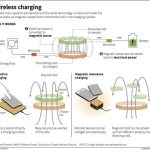
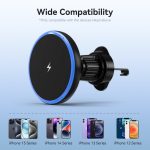
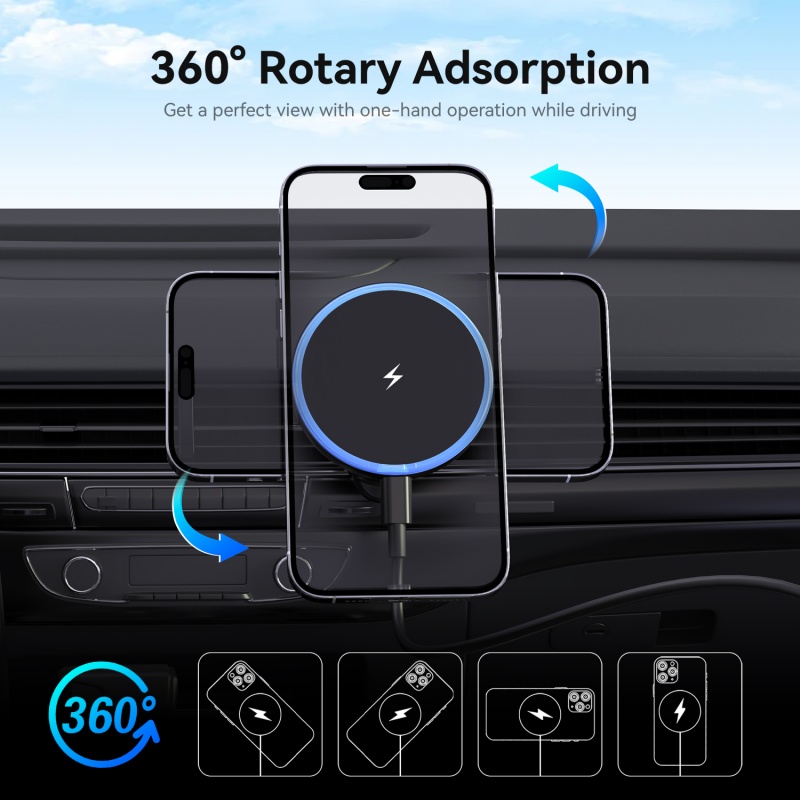
By “magnetic wireless phone chargers for car”, I refer to car-mounted charging devices that rely on magnetic alignment (often based on MagSafe or magnetic‐Qi designs) plus inductive charging coils to charge an iPhone (or similar smartphone) while mounted in a car. These combine a magnetic mount (to hold the phone securely) with wireless power transfer, so that once the phone snaps in, charging begins — no cables needed beyond the charger’s own power feed.
These devices are popular for convenience, especially during drives where the phone may be used for navigation, music, or hands-free calls. But “safe” means more than “will it charge”; it also means: does it risk damaging the iPhone, reducing battery life, causing overheating, interfering with sensors or electronics, or otherwise posing problems — and does it remain safe under the real-world conditions found in a car (heat, vibration, movement, etc.).
As someone working in “intelligent charging,” I can say: yes — magnetic wireless car chargers can be safe for iPhones, but only if certain conditions are met. There are also risks and trade-offs. Below I break down what we know, what to watch out for, and best-practice recommendations.
What Makes Magnetic Wireless Charging Generally Compatible with iPhones
• iPhone’s Qi / MagSafe design is magnet- and wireless-charging ready
Modern iPhones support wireless charging via the open standard Qi — and newer iPhones add MagSafe, which uses built-in magnets to ensure proper alignment.
Thus, if the charger is well designed (proper coil alignment, magnets positioned correctly), the iPhone receives power just like any other Qi/MagSafe pad. A magnetic car mount + charger does not inherently conflict with iPhone’s internal hardware.
• Magnets themselves don’t interfere with phone data or battery
Modern smartphones, including iPhones, use solid-state flash memory (not magnetic storage), so magnets won’t corrupt data.
Moreover, a properly designed magnetic mount should not induce harmful magnetic fields strong enough to affect internal components — especially given that iPhones already have embedded magnets (for MagSafe, speakers, vibration motor, etc.).
• When built properly, the system can incorporate safety features
Good-quality wireless car chargers often include: foreign-object detection, over-temperature protection, over-current/over-voltage protection, and regulated power management. These help ensure that charging is stable and safe even when the car is parked, moving, or exposed to varying environmental conditions.
So, in principle, a magnetic wireless charger — especially a well-designed, certified one — is compatible and generally safe for iPhones.
Real Risks & Challenges: Why “Safe” Depends on Quality, Use, and Environment
However, there are several caveats and risk factors. Under certain circumstances, use of a magnetic wireless charger in a car may degrade battery health, cause overheating, reduce charging efficiency, or lead to physical or sensor issues.
1. Heat generation and battery health
Wireless charging is inherently less efficient than wired charging, and as a result some of the energy is lost as heat. With magnetic wireless charging (particularly MagSafe or strong-magnet systems), this inefficiency can be amplified if coil alignment isn’t perfect or if the charger and phone are surrounded by poor ventilation.
Several sources warn that repeated use of MagSafe or other magnetic wireless chargers can lead to higher operating temperatures, which — if sustained — might accelerate battery degradation over time. comtar.com+2Anker+2
In a car, conditions are often less controlled: direct sunlight, heat buildup inside a closed vehicle, limited airflow — all of these can exacerbate overheating risk. For example, some manufacturer manuals for car wireless chargers explicitly caution against using the charger if the ambient temperature is high (e.g., car parked under sun).
Thus, especially during long drives, hot weather, or frequent charging sessions, wireless charging in a car can become a factor that gradually reduces battery longevity, unless care is taken.
2. Mount grip, alignment, and physical risk
Not all magnetic mounts are equal: a weak magnet or poor mount design may cause the phone to slip, fall, or detach — especially on bumpy roads or sudden stops.
If a phone falls, that’s a risk of physical damage — cracked screen, broken housing, etc.
A misalignment between charging coils (for example if the magnetic ring is slightly off-center) may lead to inefficient charging or intermittent charging, causing additional heat, battery stress, or even failure to charge reliably.
3. Environmental & usage factors (car-specific)
Temperature extremes: Cars — especially if parked in sun, or in climates with high temperatures — can easily exceed safe operating temperatures for both electronics and batteries. Wireless charging adds an extra thermal load. Manufacturer guidance for many car wireless chargers warns against use when ambient temperature is too high.
Vibration and motion: Even good mounts may loosen over time; repeated insertion/removal under motion can stress the magnetic connectors and cause wear.
Use while charging: Common use cases involve running navigation apps, streaming, etc., while wirelessly charging. That adds CPU and radio load, generating additional heat. Combined with wireless-charging heat, this can push temperatures to suboptimal levels.
Variable power supply: A car’s power system may have more fluctuation (voltage changes, surges) compared to a stable home outlet. A charger must have good protection circuitry; cheap or unbranded chargers may not.
4. Sensor interference (less common but possible)
Magnets near a phone can sometimes interfere with sensors, notably the magnetometer (used for compass/direction). That can temporarily distort navigation, especially if you rely on compass-based orientation during driving.
While data storage is safe (flash memory is not affected by magnets), this kind of interference can still degrade user experience — e.g., incorrect compass readings, GPS orientation problems.
Under What Conditions Are Magnetic Wireless Car Chargers “Safe Enough”?
Putting together what we know: using a magnetic wireless charger in a car can be acceptably safe — if you choose quality hardware and follow good usage practices. Key conditions that help ensure safety:
- Use a certified or high-quality MagSafe / Qi2 charger with proper alignment and safety circuitry (over-temperature, surge protection, foreign object detection, etc.).
- Use a MagSafe-compatible case or no case, and avoid thick/magnetic/metal-reinforced cases that can disrupt alignment or heat dissipation.
- Ensure good airflow / ventilation — avoid leaving the phone mounted while parked under sun, or during weather extremes. If possible, mount near an air vent (but not directly obstructing airflow).
- Avoid long charging sessions in hot conditions — for example, don’t leave your phone charging all day in a parked car under direct sun.
- Avoid heavy usage (GPS navigation, video streaming, gaming) while wirelessly charging — especially under conditions that may cause the phone to heat up.
- Check the mount regularly — ensure it remains stable, magnets are secure, the charger cable and connection remain intact. Replace if you notice wear, instability, or overheating.
Summary: Are Magnetic Wireless Car Chargers “Safe for iPhones”?
Yes — but with conditions. A magnetic wireless car charger is not intrinsically unsafe for an iPhone. If designed and used properly, it offers a convenient and reasonably safe way to charge your phone on the go. iPhones are built to support wireless (Qi / MagSafe) charging, and the magnets involved pose no threat to data or the battery under normal magnetic strengths.
However, there are real risks — especially overheating, reduced battery lifespan, inefficient charging, or physical damage — particularly when using low-quality or uncertified chargers, in high-heat environments, with heavy phone use during charging, or with unstable mounts. Over time, repeated exposure to heat, misalignment, and sub-optimal conditions could accelerate battery aging or compromise user safety (e.g., if the phone falls while driving).
Therefore, whether such a charger is “safe enough” depends heavily on the quality of the charger and how carefully you use it.
Final Recommendations (as an Industry Expert)
If I were advising a buyer or designing policy for intelligent charging products, here are my top recommendations:
- Choose chargers from reputable vendors — ideally certified MagSafe / Qi2 devices with stated compliance to safety standards. Avoid generic “cheap” chargers with strong magnets but poor electronic or thermal design.
- Use MagSafe-compatible cases or no case, to ensure proper alignment and heat dissipation.
- Mount carefully — avoid poorly secured clips on vents, avoid placing near airbags, and position so that airflow is available.
- Monitor heating — if your phone becomes “very warm” to the touch during charging or after a navigation session, disconnect and let it cool.
- Prefer wired charging when possible — for long trips, heavy phone use, or in hot weather, a wired connection remains more efficient and less thermally stressful than wireless charging.
- Use wireless charging more for convenience than as the default — treat it as a helpful convenience (e.g., quick top-ups, short drives), not as a permanent charging method that you rely on exclusively.
Conclusion
Magnetic wireless car chargers — when built to spec and used responsibly — are a practical and generally safe solution for iPhone users who want cable-free charging on the go. The underlying technologies (Qi/MagSafe, magnetic alignment, inductive power) are compatible with iPhone hardware. Nonetheless, because automotive environments pose challenges — heat, vibration, varying power supply, heavy usage — there remain real trade-offs.
If you value battery health, longevity, reliability, and safety, then a high-quality, certified charger used with care (good ventilation, occasional use, mindful of heat) can indeed be part of a healthy charging routine. But if you choose cheap or uncertified gear, or push the charger beyond safe operating conditions (heat, heavy usage, long sessions), then the convenience may come at the cost of battery longevity or even device safety.
You May Like
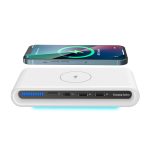
 USB multi-port 15W wireless charger+3USB interface
- Are Wireless Chargers Safe for Smartphones?
- How to Choose a Wireless Charger Manufacturer in China
- European Style 5Ft Wiring Board with USB and Type-C Power Socket EU Style with Wire Strip
- How a Wireless Phone Charger for Car Works While Driving
- Three-in-one foldable magnetic wireless charger
- Rechargeable Car Air Freshener
- US standard 3-hole socekt+2USB+1TYPE-C socket+Wireless charge
- Do Wireless Chargers Need Special Adapters or Plugs?
- Do Wireless Chargers Work with Phone Cases?